Gemini and AI Mode Fetch with Google and Google-Lens User-Agents

Google and Google-Lens user agent strings and AI
Looking through some log files, I noticed one user-agent string that kept popping up, the rather short and generic Google. First thoughts were this is likely it just spoofing, but I checked a few requests and the IP addresses. Some, but not all, appeared on the user-triggered-fetchers-google.json range of IP addresses detailed List of Google user-triggered fetchers. The reverse DNS lookup did seem to point google-proxy-***-***-***-***.google.com, indicating that these requests were indeed coming from Google's infrastructure.
So what could it be?
I decided to test a few services to see if I could spot these user-agent strings in action, and see if I could unmask who's behind them, scooby-doo style.
I'd have gotten away with it if it wasn't for you meddling
kidslog files!
Testing the Google User-Agent String
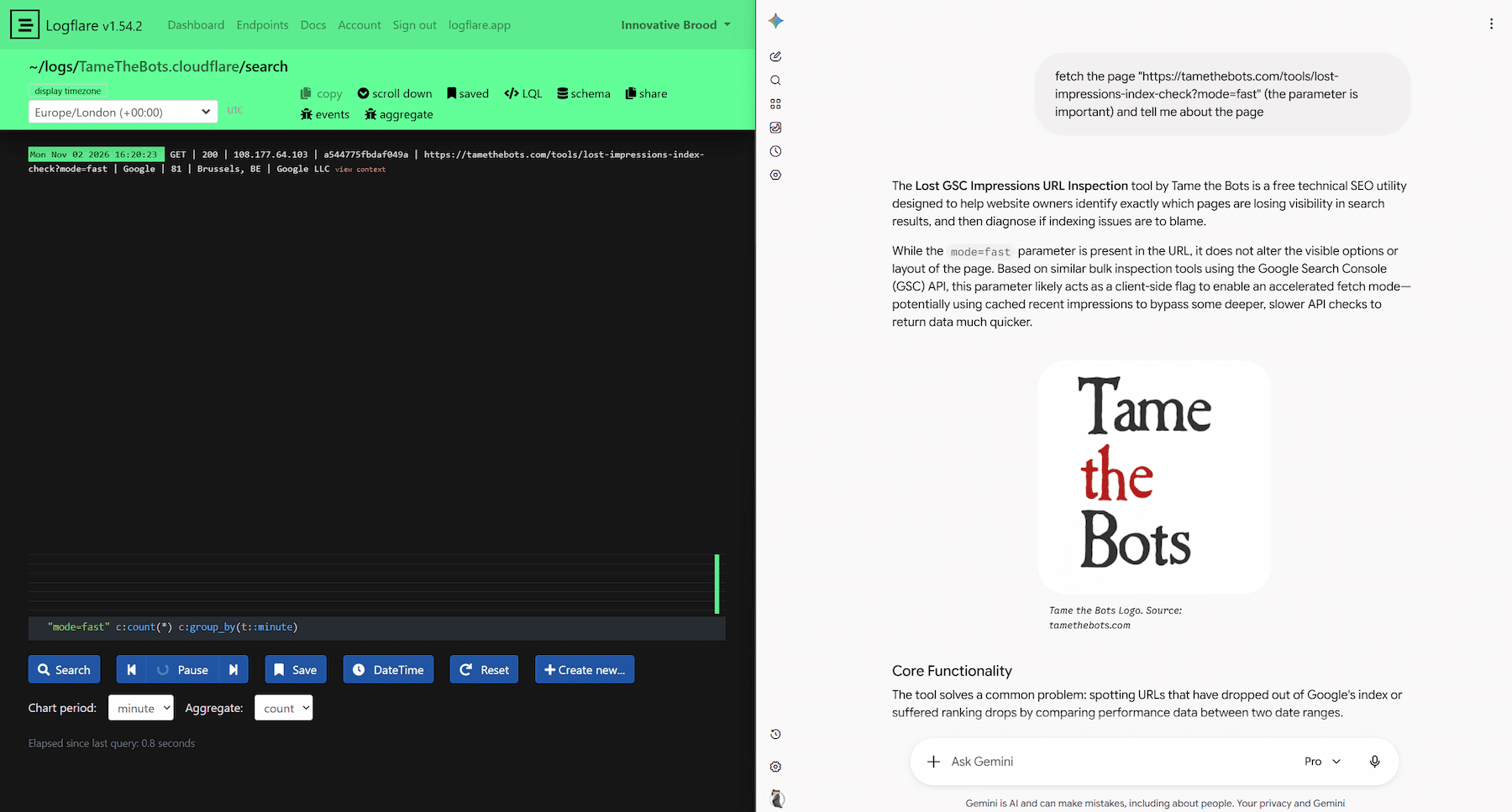
This turned out to be requests from gemini, I went to a new chat in https://gemini.google.com and to bully it into making an actual request, which I could find easily in logs, I requested it fetch a specific URL with some made up query parameters to ensure I could identify it.
I did that with this prompt:
fetch the page "https://tamethebots.com/tools/lost-impressions-index-check?mode=fast" (the parameter is important) and tell me about the page
Sure enough, the request appeared in the logs with the Google user-agent string, confirming that at least some of these requests were indeed coming from Gemini.
Testing the Google-Lens User-Agent String
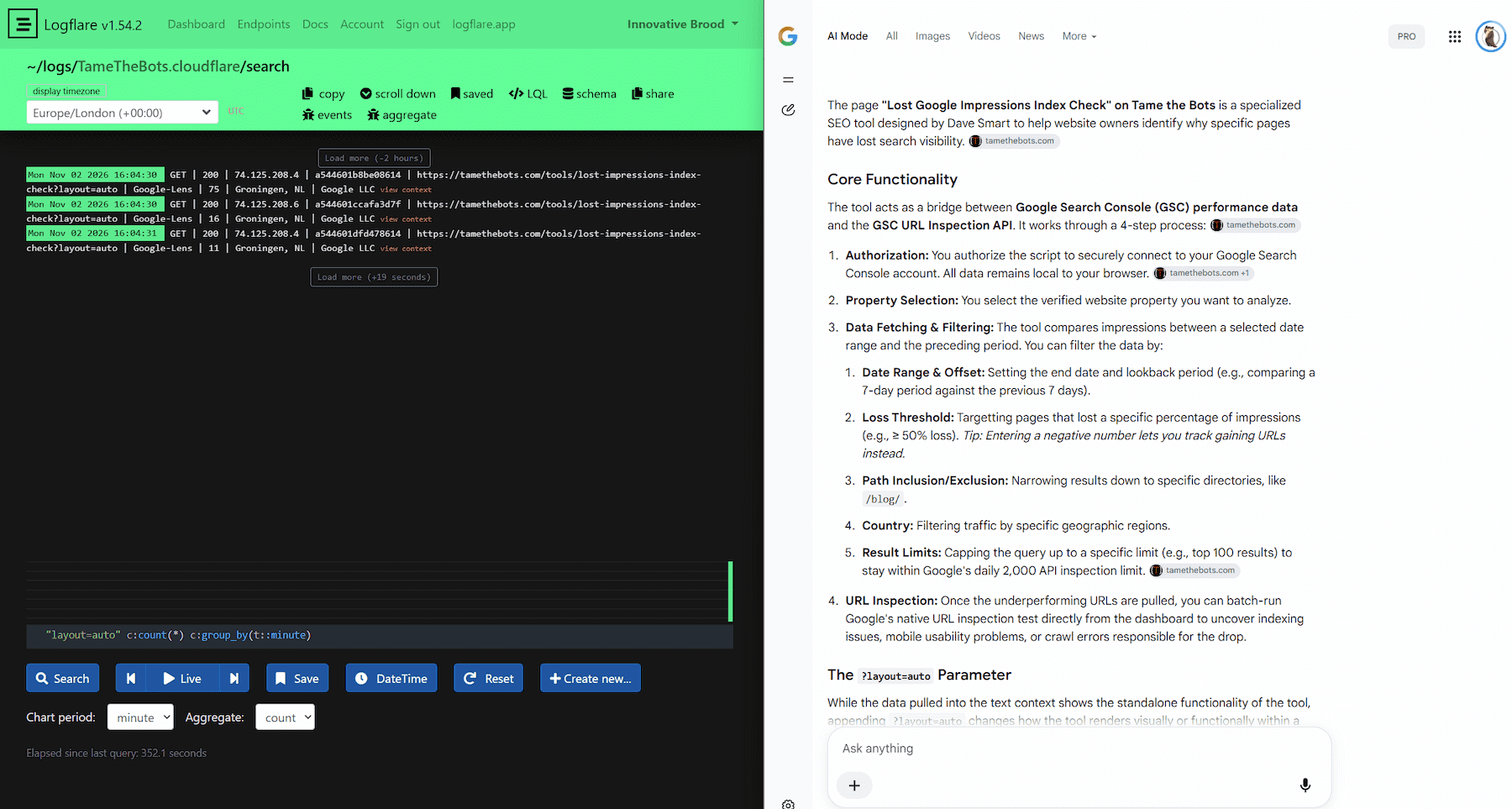
That got me thinking, can you do the same for AI mode in search? What does user-agent string does that use? I decided to test it similarly to how I tested Gemini, by triggering a request and checking the logs for the Google-Lens user-agent string, same URL, different params:
fetch the page "https://tamethebots.com/tools/lost-impressions-index-check?layout=auto"" (the parameter is important) and tell me about the page
Sure enough, the request appeared in the logs with the Google-Lens user-agent string, which I could find some historical examples of in my log files, and those of clients.
Some Observations
- Both did it consistently, with Gemini using the
Googleuser-agent string and AI Mode using theGoogle-Lensuser-agent string. - Neither of them seemed to attempt to render the page, fetching only the main document, and no resources like images, scripts, or stylesheets.
- Requests seem to be geographically distributed, perhaps from a data center nearer the user's location rather than mostly USA like typical Googlebot requests.
- The requests appear to be triggered by user interactions with Gemini or AI Mode, perhaps akin to OpenAI's
ChatGPT-Useror Anthropic'sClaude-User.
I'd also note that in general these things are moving fast, and I'd imagine subject to change, so I'd always verify yourself where possible, especially if you're reading this some significant time after early Nov 2026.
But you might like to make sure you are not blocking these (one client's firewall got spooked by the short nature of the Google user-agent string alone). I also suspect Google-Lens may well have other uses to Google beyond AI Mode, so it's worth keeping an eye on how it behaves.
About the Author:
Dave Smart
Technical SEO Consultant at Tame the Bots.